If you’ve ever hit the gym during peak hours—say, 6 PM on a weekday—you’ve probably hovered nearby, waiting for someone to finish with the triceps press machine. It’s one of the most contested pieces of equipment on the floor, and for good reason: personal trainers swear by it for building strong, defined triceps (and even boosting full-body lifts). Let’s break down why it’s non-negotiable for arm day (and beyond)—plus the critical do’s and don’ts to use it safely.

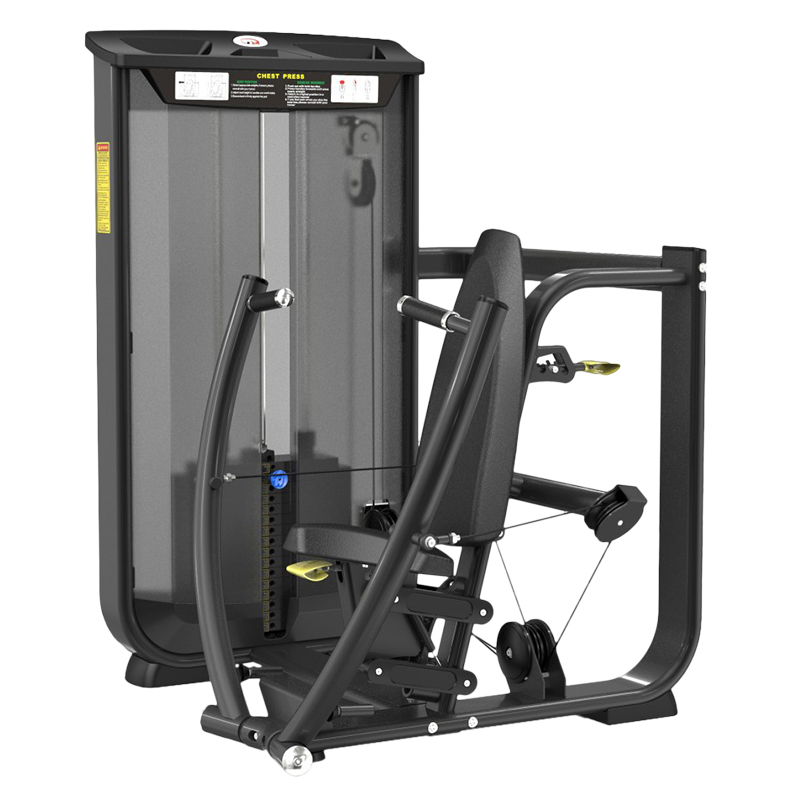
First, it’s incredibly accessible for all fitness levels. Unlike free-weight tricep moves (think overhead dumbbell extensions) that demand strict form to avoid shoulder strain, the triceps press machine locks your body into a stable, supported position. Newbies can master the movement in 60 seconds flat: adjust the seat so your elbows align with the pivot point, grip the handles (palms facing down or in—most machines offer options), and push until your arms are nearly straight (don’t lock the elbows!). Even advanced lifters benefit: the machine eliminates “cheating” (no swinging your torso to eke out a rep), so you isolate the triceps completely—targeting that coveted “horseshoe” shape with precision.
Trainers also love it for scalability and versatility. Most machines let you tweak resistance in small, manageable increments (5-10 lbs is standard), so you can gradually bump up intensity as your strength grows—no jumping from too-light to too-heavy weights. Want to switch up the stimulus? Try slow, 3-second eccentric (lowering) reps, or “drop sets”: finish a set at 50 lbs, immediately drop to 30 lbs, and crank out 10 more reps. No fumbling with plates mid-set—just smooth, focused work.
But here’s the hidden win: it’s shoulder-friendly (and joint-safe). Overhead tricep exercises (like dips or barbell skull crushers) often irritate shoulder joints, especially if you have tightness or past niggles. The triceps press machine keeps your arms in a neutral, forward-facing position, reducing stress on the rotator cuff while still lighting up the lateral and long heads of the triceps. Trainers often recommend it for clients recovering from shoulder injuries—proof that it’s effective and gentle.
Even better: it boosts full-body lift performance. Strong triceps are critical for pushing movements like bench press, overhead press, and push-ups. By building tricep strength with the machine, you’ll add power to these compound lifts: a study in The Journal of Strength and Conditioning Research found that regular tricep isolation work (like the press machine) improved bench press maxes by 8-10% in 8 weeks. Trainers know this: they’ll often slot the machine into a workout before compound lifts to activate the triceps, or after to finish them off.
Critical Triceps Press Machine Dos & Don’ts
To get the most out of the machine (and avoid injury), keep these trainer-backed tips in mind:
Do align your elbows with the pivot point: If your elbows sit too high or low, you’ll shift stress to your shoulders or chest (defeating the tricep isolation goal).
Don’t lock your elbows at the top: Fully extending your arms can strain the elbow joint—stop 10-15 degrees short of straight.
Do control the lowering phase: Letting the weight drop quickly wastes muscle engagement (and jolts your joints). Lower the handles slowly (2-3 seconds) to maximize tricep activation.
Don’t arch your back: Leaning backward to push heavier weight takes tension off the triceps—keep your core braced and torso pressed against the backrest.
Do adjust the handle width (if possible): Narrow grips target the long head of the triceps; wider grips focus on the lateral head. Mix it up for balanced growth.
Next time you see that machine open mid-peak hour? Don’t hesitate—grab it. Whether you’re a beginner chasing definition or a lifter aiming to PR your bench, it’s the trainer-approved tool that delivers results (without the hassle of free weights)—as long as you stick to these simple rules.