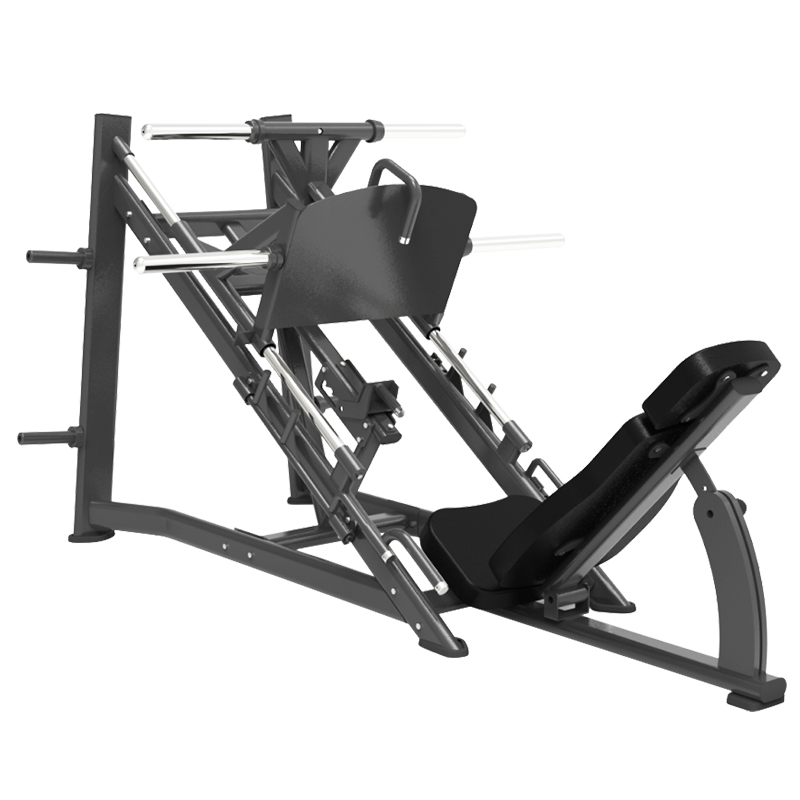
If you’re hunting for a leg exercise that builds dense muscle without torching your joints, the seated leg press isn’t just an option—it’s a non-negotiable addition to your routine. Here’s why it’s become a gym staple for hypertrophy (muscle growth) and long-term training safety, especially for lifters who struggle with squats or have pre-existing joint discomfort.

First, it targets 3 major lower-body muscle groups with unrivaled precision. When you push the weighted sled through its fixed path:
Quadriceps (thigh front): The primary driver of the movement, particularly when feet are positioned high on the platform—this stance shortens the hip’s range of motion, shifting maximum tension to the quads’ upper fibers for thicker, more defined thighs.
Glutes: Fully ignited when feet sit low and wide on the plate: this setup deepens hip extension, forcing your glutes to fire hard to push the sled forward, resulting in a fuller, stronger posterior chain (critical for both aesthetics and functional strength).
Hamstrings: Engaged intensely during the eccentric (lowering) phase as you control the sled back toward your body. This slow, controlled movement hits the hamstrings’ fast-twitch fibers—often neglected in quad-dominant exercises—boosting overall leg thickness and balance.
Unlike barbell squats (which demand full-body stability, core strength, and perfect form to avoid injury), the seated leg press’s machine-supported design eliminates spinal and knee strain. The backrest holds your torso steady, so you can lift heavier loads (often 25–35% more than your squat max) while keeping joints in a safe, controlled range of motion. This is a game-changer for:
Beginners: Who can master muscle engagement without worrying about balancing a barbell.
Injured lifters: Who need low-impact leg work to maintain size during recovery.
Volume chasers: Who want to crank out 15+ rep sets without risking back or knee setbacks.
But it’s not just about safety—this exercise is hyper-scalable for every fitness level. Newbies can start with light weights to nail form; advanced lifters can amp up intensity with:
Drop sets: Lowering the weight after failure to extend muscle fatigue.
Slow eccentric reps: Taking 3–4 seconds to lower the sled to amplify muscle tension.
Foot-position variations: Narrow, wide, high, or low stances to target specific muscle fibers (e.g., narrow feet for inner quads, wide feet for outer glutes).
Since you’re seated, core fatigue won’t cut your sets short—meaning you can focus exclusively on frying your legs with high-rep, high-weight work (the sweet spot for hypertrophy).
Critics often dismiss the seated leg press as a “lazy squat alternative,” but that’s a myth: it’s a specialized tool that delivers targeted, high-volume leg growth while protecting your body. For lifters chasing thick, strong legs and long-term training consistency, this machine is the definition of a hypertrophy powerhouse.