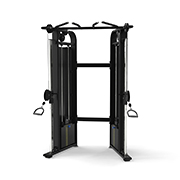
If you’re tired of juggling 5+ gym machines to hit every angle of your upper body, the adjustable cable crossover might be your new workout MVP. This versatile piece of equipment isn’t just for commercial gyms—modern compact models fit home setups (even small garages or spare rooms) too, and its customizable pulleys let you target every fiber of your chest, shoulders, and arms without switching stations. For anyone chasing defined, balanced upper-body muscle (not just “big” muscles), this machine is non-negotiable.

Let’s break down why it’s a game-changer for full upper-body definition:
Chest: Hit Every Bundle (No More Flat, Uneven Pecs)
Most free-weight chest moves (like barbell bench presses) favor the middle chest but neglect the upper fibers (key for “peaked” pecs) or inner muscles (critical for separation). The adjustable cable crossover fixes this:
Lower pulleys (chest height): Wide-grip flyes stretch outer pecs for width—lean forward slightly to amplify the stretch.
High pulleys (shoulder height): High crossovers target the upper chest (the “cap” that makes pecs look 3D)—keep your elbows slightly bent to avoid shoulder strain.
Angled pulleys: Tilt handles inward for close-grip cross-body pulls to tighten inner chest (perfect for that “cleavage” line bodybuilders chase).
Pro tip: Slow the eccentric (lowering) phase to 3 seconds, and squeeze the pecs hard at the top of each rep—this doubles muscle activation compared to fast, sloppy movements.
Shoulders: Round, Capped Delts (Front, Side & Rear)
Weak rear delts (the small muscles behind your shoulders) lead to rounded posture and “narrow” shoulders—most machines ignore them, but the cable crossover doesn’t:
Low pulleys: Standing front raises (hold handles with palms down) blast front delts (the “push” muscle for presses).
Mid-height pulleys: Lateral raises (keep arms parallel to the floor) carve side delts (the muscle that adds width to your frame).
High pulleys: Reverse flyes (bend at the waist, pull handles outward) target rear delts—do 3 sets of 15 reps here to fix imbalances from bench pressing.
Adjusting the pulley angle by 15 degrees shifts tension to stubborn spots (e.g., a slight upward angle hits the top of the side delt better than a flat pull).
Arms: Chiseled Biceps & Triceps (No Isolation Machines Needed)
Dumbbells only hit arms in one plane of motion—cables keep tension constant through every rep:
Biceps: Use high pulleys for cable curls (keep elbows tight to your sides to target the long head, which lifts biceps peaks) or low pulleys for cross-body curls (twist your wrists at the top to hit the short head, adding thickness).
Triceps: Low pulleys + overhead extensions (lock your elbows above your head) carve the lateral head (the “horseshoe” shape), while mid-pulleys + pushdowns (keep your core tight) target the medial head (the inner tricep muscle that adds definition).
For extra intensity, add a 2-second squeeze at the end of each arm rep—you’ll feel the burn in muscles dumbbells rarely reach.
Why It Beats Single-Function Machines (For Home & Gym Users)
Unlike a dedicated chest fly machine or shoulder raise station, the adjustable cable crossover adapts to your body (adjust pulley height for tall/short frames) and your goals (switch from 12-rep hypertrophy sets to 6-rep strength sets in 10 seconds). Even small home gyms can replace 3+ machines with this one tool—saving space and money. For commercial gym-goers, it cuts workout time by 30% (no more waiting for the shoulder machine mid-rush hour).
Ready to stop wasting time hopping between stations? The adjustable cable crossover turns “partial upper-body workouts” into full, targeted sessions—all from one piece of equipment. Whether you’re a beginner building a home gym or a pro chasing better muscle separation, this machine delivers results you can see (and feel) in 4–6 weeks.