When stepping into a gym, two pieces of equipment often spark debates among fitness enthusiasts: the multifunctional trainer and the Smith machine. Both cater to strength training, but they differ drastically in design, functionality, and suitability for different users. Understanding their pros and cons is key to choosing the right tool for your fitness goals. Let’s break down the comparison.

Design & Core Functionality
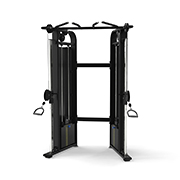
The Smith machine features a barbell guided by fixed rails, with built-in safety stops. It eliminates the need for a spotter, as the bar can be locked into place at any height. This design prioritizes stability and safety, making it accessible for beginners. In contrast, a multifunctional trainer (also called a cable cross machine) uses adjustable cables attached to weight stacks. It offers dual independent cables, allowing for bilateral or unilateral movements, and supports a wide range of exercises from pulls to pushes, rows to flyes.
Muscle Engagement & Training Effectiveness
One of the biggest gaps lies in muscle activation. The Smith machine’s fixed path reduces the need for stabilizer muscles—muscles that stabilize joints during free-weight movements. This can limit functional strength gains, as real-life movements aren’t restricted to fixed paths. For example, squats on a Smith machine target quads but engage fewer core and glute stabilizers than free squats.
The multifunctional trainer, however, boosts functional fitness. Its cable system mimics real-world motions, forcing stabilizer muscles to work harder. Unilateral exercises (e.g., single-arm rows) correct muscle imbalances, while adjustable resistance lets you fine-tune intensity. It also supports dynamic movements like cable woodchops or lateral raises, which are hard to replicate on a Smith machine.
Suitability for Different Users
Beginners or those training alone often favor the Smith machine. Its safety features reduce injury risk when learning basic lifts like bench presses or squats. It’s also ideal for targeting specific muscles with controlled movements, such as leg curls or shoulder presses for hypertrophy (muscle growth).
Advanced lifters or those pursuing functional strength tend to prefer multifunctional trainers. The versatility supports complex routines, and the lack of fixed paths challenges the body to adapt—critical for athletes or anyone aiming to improve daily mobility. It’s also great for rehabilitation, as gentle, controlled movements aid recovery without straining joints.
Limitations to Consider
The Smith machine’s fixed path can lead to poor form over time. Relying on it may hinder progress in free-weight exercises, as stabilizer muscles remain underdeveloped. It also has limited exercise variety—mostly restricted to compound lifts.
Multifunctional trainers have higher learning curves. Mastering cable tension and proper form for each exercise takes time. They’re also more space-consuming and expensive, making them less common in home gyms compared to compact Smith machines.
Final Verdict
There’s no one-size-fits-all answer. Choose the Smith machine if you’re a beginner, train alone, or prioritize safety and controlled muscle growth. Opt for a multifunctional trainer if you want versatility, functional strength, or to correct muscle imbalances. Many fitness enthusiasts combine both: using the Smith machine for foundational lifts and the trainer for accessory work. Ultimately, the best tool is the one that aligns with your goals, experience level, and training style.