If you’re new to the gym or looking to upgrade your home setup, two pieces of equipment you’ll often hear about are the Smith machine and the squat rack (also called a power rack). Both are used for squats and other compound lifts, but they work in very different ways. Understanding the differences will help you choose the right tool for your goals and training style.

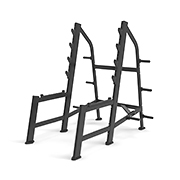
First, let’s look at how they’re built. A Smith machine has a barbell that’s fixed within steel rails, so it can only move up and down in a straight line. The bar is also usually counterbalanced, meaning it feels lighter than its actual weight, and many models have safety stops or “catches” that can prevent the bar from dropping too low. On the other hand, a squat rack is a four-post or two-post frame that holds a standard Olympic barbell. The bar is completely free to move in any direction, so you have full control over the path and balance of the weight.
One of the biggest differences is stability and safety. Because the Smith machine guides the bar, it can feel safer for beginners who may not yet have good squat form or core stability. The fixed path reduces the risk of losing balance, and the safety stops can give you peace of mind when lifting alone. However, this safety comes at a cost: the machine doesn’t train your stabilizer muscles as effectively as free weights. When you squat on a Smith machine, your body doesn’t need to work as hard to keep the bar balanced, which can lead to weaker stabilizer muscles over time.
A squat rack, by contrast, requires you to stabilize the bar yourself. This means more muscle groups are involved in each rep, including your core, lower back, and hips. Training with free weights on a squat rack is generally better for building overall strength and functional fitness, as the movement pattern is more natural and closer to real-life activities. However, it does have a steeper learning curve. You need to learn proper form, how to unrack and rerack the bar safely, and it’s highly recommended to use spotters or safety bars when lifting heavy.
Another key difference is movement pattern. The Smith machine’s fixed path might feel comfortable at first, but it may not match your body’s natural squatting motion. Everyone has slightly different limb lengths and joint angles, so a one-size-fits-all vertical path can sometimes lead to discomfort or even strain, especially in the knees or lower back. With a squat rack, you can adjust your stance, bar path, and depth to fit your body, which is generally better for long-term joint health.
When it comes to muscle activation and training goals, both have their place. The Smith machine can be useful for beginners practicing the squat movement, for isolating certain muscles by changing foot position, or for people recovering from injuries who need a more controlled environment. It’s also popular for exercises like bench press, shoulder press, and lunges in some gyms. However, if your goal is to build maximum strength, improve athletic performance, or develop a well-rounded physique, the squat rack is usually the better choice. Compound lifts like back squats, front squats, overhead presses, and deadlifts (when used with a rack) are foundational movements that offer great benefits for muscle growth and metabolism.
In terms of versatility, a squat rack also has the upper hand. You can perform a wider variety of exercises with it, including not just squats but also pull-ups (if equipped with a bar), dips, rows, and even core work. Many power racks come with additional attachments like weight storage, landmine stations, and cable systems, making them a complete home gym solution. A Smith machine is more limited in comparison, as it’s mainly designed for guided barbell exercises.
Cost and space are also factors to consider. A basic Smith machine can be expensive and takes up a significant amount of floor space. A squat rack, especially a compact or foldable model, is often more affordable and can be adapted to smaller rooms. If you’re on a budget or short on space, a squat rack with a quality barbell is usually a better investment.
So, which one should you choose? If you’re a beginner who wants to feel more secure while learning squats, or if you prefer a more controlled movement for specific exercises, a Smith machine can be a good starting point. But if you’re serious about strength training and want a tool that will grow with you, a squat rack is the clear winner. It offers more freedom, better muscle activation, and greater versatility, making it essential equipment for any serious lifter.
In conclusion, the Smith machine and squat rack are not interchangeable. The Smith machine provides stability and guidance, while the squat rack offers freedom, versatility, and superior training value. By understanding these differences, you can make an informed decision that aligns with your fitness goals and helps you get the most out of your workouts.