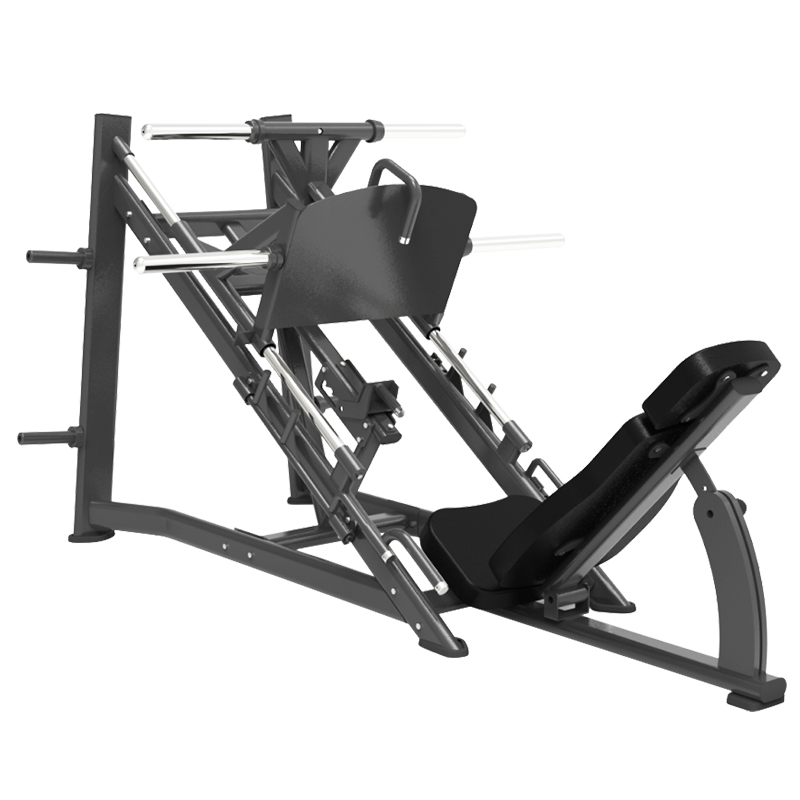
If you want to build stronger, firmer, and more defined leg muscles without complicated compound movements like squats, the leg press machine is your ultimate fitness companion. It is one of the most versatile gym equipment pieces that targets almost every muscle group in your lower body, including quads, glutes, hamstrings, calves, and inner thighs. With proper form and a scientific training plan, this single machine can help you fully sculpt balanced and attractive leg lines safely and efficiently.

Many gym enthusiasts make common mistakes when using the leg press machine, such as overloading weight, incorrect foot placement, and improper range of motion. These errors not only reduce training efficiency but also bring hidden risks to the knees, waist, and lower back. Mastering the standard usage method is the first step to maximizing your leg training results and avoiding unnecessary injuries.
First, adjust the machine to fit your body size before starting. Sit firmly on the seat, keep your back and hips tightly attached to the backrest, and maintain a natural slight arch in your lower back. Place your feet shoulder-width apart on the middle area of the footplate. Avoid placing your feet too high or too low, as improper positioning will shift the muscle stimulation and cause joint pressure. Grip the side handles steadily to stabilize your upper body and keep your head neutral without hunching forward.
Next, control the movement rhythm slowly and steadily. Unlock the safety lever and slowly lower the footplate until your knees form approximately a 90-degree angle. Do not sink too deep to prevent your hips from lifting off the seat, which may strain the lumbar spine. Push the plate upward with the force of your heels and entire soles until your legs are nearly straight, but never fully lock your knees. Maintain continuous muscle tension throughout the entire set, and avoid using inertial bouncing to complete the movement.
Different foot positions can create targeted training effects. Placing feet in the middle focuses on quadriceps; a higher foot position activates more glutes and hamstrings; a narrower stance targets inner thighs, while a wider stance works outer thighs and hip muscles. You can change foot placement regularly to achieve all-round leg muscle shaping and break training plateaus.
For training arrangements, beginners can choose moderate weight with 12 to 15 reps per set, 3 to 4 sets in total. Advanced fitness lovers can increase weight appropriately and adjust reps according to muscle growth or strength goals. Always prioritize standard form over heavy weight, and rest for 60 to 90 seconds between sets for better recovery.
In conclusion, the leg press machine is perfect for people of all fitness levels to shape and strengthen their legs. By following this complete usage guide, mastering correct posture, adjusting foot placement reasonably, and controlling movement rhythm, you can easily achieve comprehensive leg shaping, build stable lower body strength, and make your leg lines tighter, more symmetrical, and more aesthetic.