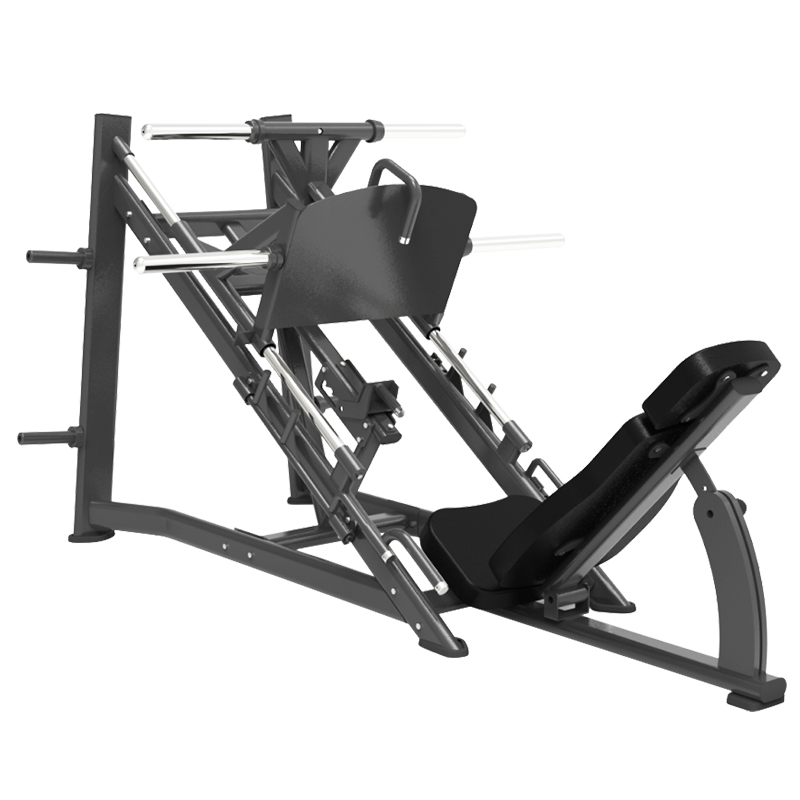
If you want to build strong, defined lower-body muscles without putting excessive strain on your spine, the 45-degree leg press machine is one of the most reliable staples in any gym. Popular among beginners and seasoned lifters alike, this equipment lets you load significant weight to target your quads, glutes, hamstrings, and calves while keeping your torso supported. Unlike back squats, which demand solid core stability and technical skill, the 45° leg press lowers the barrier to effective leg training, but only when performed with correct form.

One of the biggest advantages of the 45 degree leg press is its adjustable muscle activation. With your back securely pressed against an inclined pad, your spine stays neutral, reducing compression compared to free-weight leg movements. This makes it a great rehabilitation-friendly exercise for those recovering from mild knee or back discomfort, as long as the range of motion is controlled. You can shift the focus easily: placing feet high on the plate prioritizes glutes and hamstrings, while lower foot placement emphasizes quadriceps. It also supports progressive overload simply by adding weight plates, which is critical for long-term muscle growth and strength gains.
Mastering proper form is non-negotiable to unlock these benefits and prevent injury. Start by sitting comfortably with your entire back and head against the padded support. Plant your feet shoulder-width apart on the press plate, toes slightly turned outward. Grip the safety handles firmly, engage your core, and release the safety stoppers slowly. Inhale as you bend your knees to lower the plate, continuing until your knees form roughly a 90-degree angle. Avoid letting your knees cave inward or flare far past your toes. Push through your whole foot, especially your heels, to extend your legs upward while exhaling. Do not lock your knees fully at the top of the movement, as this places dangerous stress on knee joints. Once you finish your set, re-engage the safety locks before releasing the weight.
Even experienced gym-goers frequently make avoidable mistakes on the leg press. The most common error is loading far too much weight. Heavy loads tempt lifters to shorten their movement range, turning the exercise into a shallow half-rep that delivers minimal muscle stimulus and spikes joint pressure. Another frequent flaw is lifting the lower back off the support pad. This shifts stress onto the lumbar spine and can lead to strains over time. Many people also let their knees cave inward during the press, which puts unhealthy torque on knee ligaments. Additionally, rushing each rep with momentum instead of controlled muscle tension wastes most of the training value.
To get the best results, integrate the 45-degree leg press strategically into your workout routine. For hypertrophy, aim for 3 to 4 sets of 10 to 12 controlled reps. If your goal is lower-body strength, use heavier weight for 4 sets of 5 to 8 reps. Pair it with complementary movements such as leg curls or calf raises for balanced leg development. Always prioritize movement quality over how much weight you can stack.
The 45 degree leg press is a versatile, accessible tool for building resilient, muscular legs. When you stick to proper technique and steer clear of typical form errors, it can safely drive consistent strength and muscle gains for lifters of every skill level.